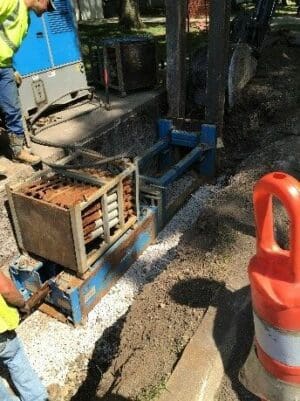
At Lamp Rynearson, we constantly aim to provide the most efficient and cost-effective solution for our clients. Open trench construction on water and wastewater systems can be disruptive to communities. With innovation and technology in engineering and construction, there are more efficient options. Trenchless technologies make it possible for water and wastewater systems to be worked on while minimizing disruption to your community.
What is Trenchless Construction?
Trenchless construction in the infrastructure field has been increasing in recent years, but what exactly is it? Trenchless construction is an umbrella term for a range of methods that allow the installation, rehabilitation, and replacement of underground utilities with minimal excavation. By reducing the need for extensive trenching, this technology minimizes disruptions to traffic and reduces the need for Improvements at the surface level. There are several methods of trenchless construction, but at Lamp Rynearson we most commonly utilize three: pipe bursting, jack-and-bore, and directional drilling. Read on to learn more about each method and how we have utilized them in communities like yours!
Pipe Bursting.
Pipe bursting is a trenchless method that is used to replace old, buried pipe. This innovative technique has emerged as a game-changer in the world of underground infrastructure replacement and rehabilitation. Pipe bursting redefines how we tackle aging or damaged pipelines without the need for extensive excavation. Instead of tearing up streets and landscapes, pipe bursting operates on the principle of controlled fracturing. A new, stronger pipe is pulled through the existing one, breaking it apart as it goes. This method is versatile and effective for various pipe materials, such as clay, concrete, and even steel.
At Lamp Rynearson, we have designed installations using pipe bursting for a waterline replacement on several projects, for example in the City of Lake Tapawingo, Missouri. This alternative construction method was suggested for this project because of the rocky subsoil and the proximity to other utilities. This allowed the new waterline to be installed in the location of the existing waterline, instead of locating a new main in a trench.
Jack-and-Bore.
Jack-and-bore, also known as auger boring, is a common method for storm and sewer construction. The process involves using a specialized machine, known as an auger boring machine. A sending and receiving pit are dug to install the new pipe. A jack-and-bore machine is set into the sending pit and cuts a hole underground horizontally from the sending pit to the receiving pit. The machine simultaneously drills the hole and functions like a jack hammer to push the new sewer pipe in place. This is all done without disturbing the surface above. The minimal surface disruption means that communities experience minimal inconveniences, with reduced traffic congestion, noise levels, and environmental disturbances.
Lamp Rynearson was contracted by the City of Omaha to lead the Nicholas Street Sewer Extension Phase 1-3 projects, which provided a further extension of sanitary and storm sewers previously designed by our firm in phase 1. Phase 2 provided combined sewer overflow relief to the north downtown area of Omaha, Nebraska. This project extended sewer pipe through an urbanized industrial corridor and single-housing residential unit neighborhoods. Due to the required depths for both the storm and sanitary sewers, traditional jack-and-bore techniques and pilot tube micro tunneling were used to meet depth requirements without impacting surrounding infrastructure.
Directional Drilling.
Directional drilling offers a different option of trenchless technology. This method allows for enhanced flexibility with route design since the pipe to be installed in a curved trajectory, whereas the other methods only allow for straight lines. It involves drilling a borehole along a predetermined path, allowing for the installation of pipes or conduits without the need for open trenching.
Lamp Rynearson utilized directional drilling on a wastewater pump station design in Louisburg, Kansas. This project included the design and approach for a stream crossing and installation through a congested cemetery and across a state highway. Directional drilling was used to install the stream across the highway with minimal disruption to traffic.
Pros |
Cons |
| · Sewer and water systems can be installed without disrupting streets
· Minimizes community destruction · Limits environmental impact, such as tree removal |
· May not be suitable for certain soil types or environmental conditions
· Unable to see if there is something that could be hit, which can lead to damage.
|
Is Trenchless Construction Right for Your Project?
If you need to limit disruptions during construction a trenchless approach might be an option to consider. possible. Our team of knowledgeable professionals will work diligently to ensure the best outcome for your community. To provide clear directions to the contractors, we conduct several site trips to identify potential construction conflicts from utilities, trees, landscaping, and traffic considerations. By identifying specific construction issues on the plans, the contractors are better aware of the construction issues at bid time, minimizing unexpected issues during the construction phase. Utilizing trenchless construction alone or in addition to other construction methods can make a project more affordable and comprehensive.
Meet the Team
Water Group Leader Chad Harrington, PE, ENV-SP, and Wastewater Project Manager Jon Shellhorn, PE have experience with water and sewer layouts, design, and construction including trenchless and traditional methods for construction. Do you have more questions about trenchless technologies or would like to learn more? Get in touch with our team.